Dublin’s Public Transport System Is Failing Its People Hard
High Prices, Low Reliability, Zero Accountability, Ireland’s Public Transport Doesn’t “Struggle.” It Fails.
Dublin Bus and Go-Ahead Ireland cancel thousands of services while commuters pay premium prices for unreliability
A capital city cannot function when its transport system lies by default
Dublin’s public transport system does not merely struggle. It fails, repeatedly, predictably, and without meaningful consequence. Every weekday morning, thousands of people organise their lives around bus timetables that function more as loose aspirations than commitments. When the bus does not arrive, the system does not absorb the shock. The commuter does.
This failure is not theoretical. It plays out in missed work hours, disciplinary warnings, childcare chaos, medical appointments rescheduled, and wages quietly lost. A transport network exists to reduce friction in daily life. Dublin’s network adds friction and then asks people to accept it as normal.
Public messaging keeps framing these failures as temporary disruption. That framing is dishonest. Temporary disruption resolves. What Dublin has instead is a long running pattern of cancellations, curtailments, and so-called ghost buses that has persisted across years, operators, and contract cycles. At that point, the word disruption stops applying and systemic unreliability takes over.
A city that wants people out of cars cannot demand blind faith in buses that do not appear. Trust is infrastructure. Once it collapses, people build expensive and inefficient workarounds because they have no other choice.
The most corrosive element is expectation management. Commuters now expect failure. They leave earlier than necessary, plan redundancies into journeys, and accept that the first bus is unlikely to arrive. That behaviour protects operators from backlash because outrage fades when disappointment becomes routine.
No serious transport authority should accept a culture where the public assumes the timetable is fiction. Dublin does.
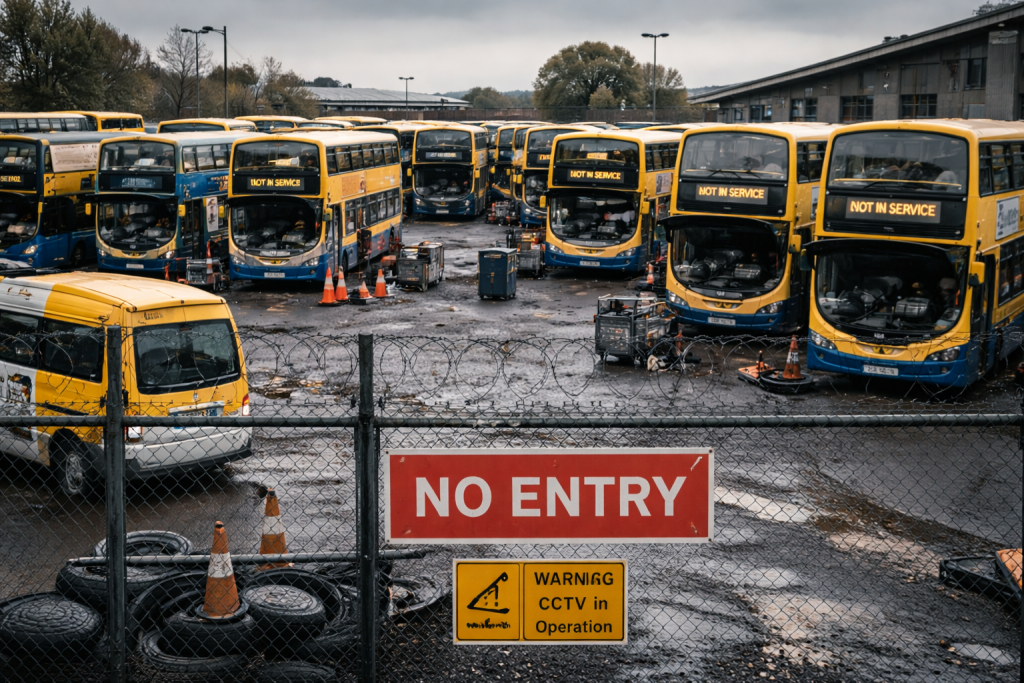
What cancellations and ghost buses actually look like on the ground
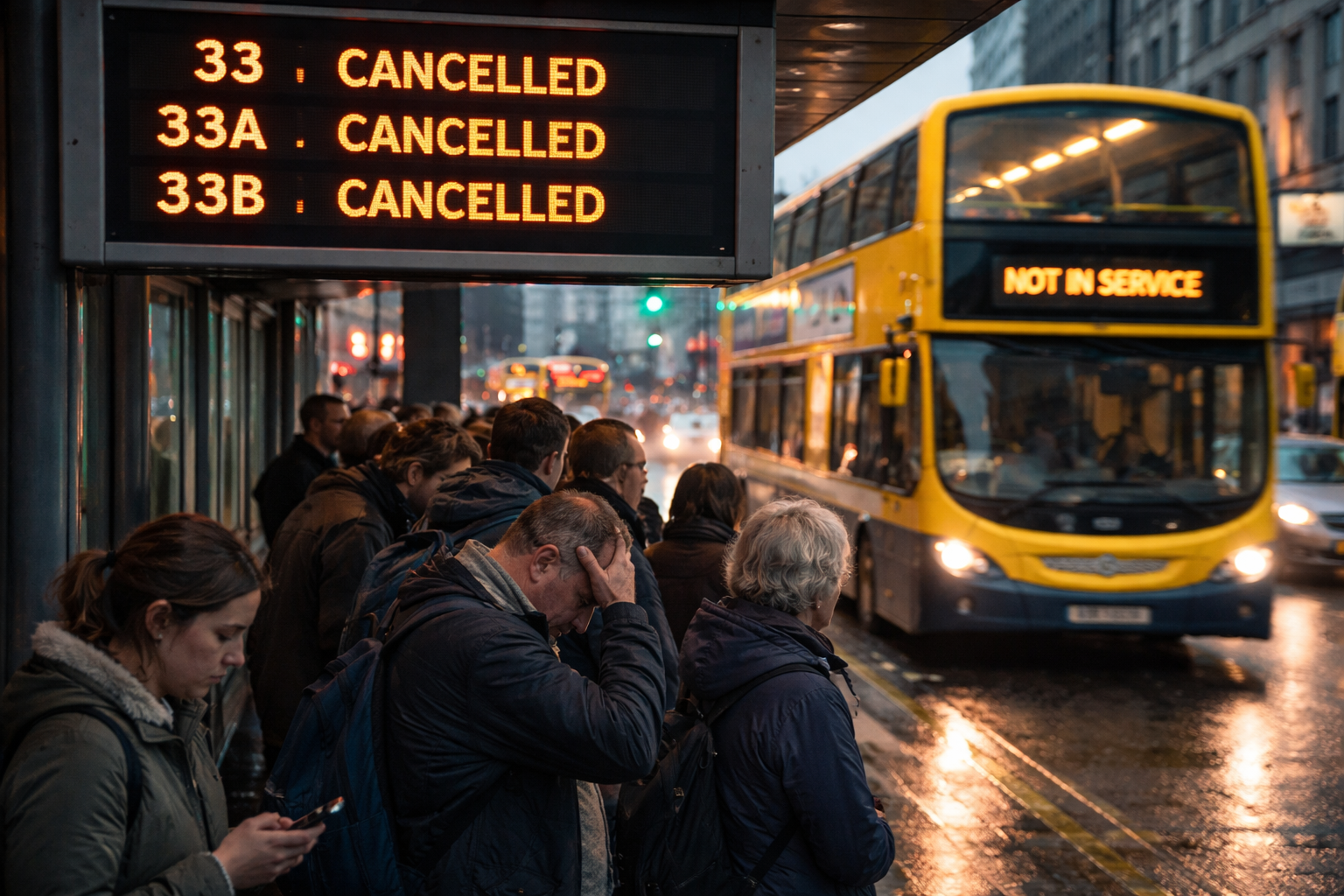
A cancelled bus at least tells the truth. A ghost bus does not. Ghost buses appear on real time displays and apps, count down as if they are approaching, then vanish without explanation. The passenger is left standing, unsure whether the service was cancelled, delayed, or never existed in the first place.
RTÉ reporting has acknowledged this phenomenon and linked part of the problem to shortages of mechanics and maintenance capacity, which leads to vehicles being pulled from service at short notice. That explanation may describe the cause, but it does not mitigate the impact on passengers.
If a system cannot maintain enough vehicles or staff to deliver the published timetable, the timetable itself becomes misinformation. When misinformation comes from an official source, public trust erodes fast.
The National Transport Authority measures performance using “lost kilometres”, meaning scheduled service that was not delivered. Operators are contractually required to meet minimum thresholds, typically around 98 percent delivery. That means the system formally tolerates a non-trivial amount of failure before consequences even begin.
Passengers do not experience lost kilometres. They experience missing buses.
Because official reporting aggregates performance across routes, chronic failures on specific corridors often disappear into averages. That is why independent tracking projects emerged, most notably the Bus Cancellations Dublin website, which collates route-level cancellation data using the NTA’s own real time feeds.
Even that project notes a critical limitation. If a bus disappears without being formally marked as cancelled, it does not appear in the statistics. In other words, the data likely understates the true level of failure.
A modern capital should not require unpaid volunteers to monitor whether its buses exist.
The 33, 33A, and 33B show how entire communities get stranded
The north county Dublin corridor served by the 33, 33A, and 33B routes has become a case study in how bad the system can get.
In an Oireachtas committee session in October 2025, it was stated on the public record that over a two month period there were 49 cancellations on the 33 route and 133 cancellations on the 33A route. That is not a seasonal blip. That is sustained collapse within a short timeframe.
The 33B, operated by Go‑Ahead Ireland, has its own documented record. According to reporting in Dublin Inquirer, during May 2025 there were only 13 days in the entire month when a 33B service was not cancelled. That means cancellations occurred on more than half the days in a single month.
For routes with lower frequency, each cancellation carries disproportionate harm. Miss two consecutive services and you are not late, you are an hour behind. For workers on fixed start times, that is not survivable without consequences.
Local councillors and TDs have repeatedly raised these routes because the complaints are not abstract. People are being forced into taxis to reach work. Others simply give up and drive, adding congestion and undermining every climate and transport policy goal the State claims to support.
Defenders often point to staffing shortages. Staffing shortages explain pressure. They do not justify publishing a timetable that cannot be delivered, nor do they justify renewing contracts without hard delivery guarantees.
When entire communities cannot rely on the only public transport link they have, the system has failed its most basic obligation.
Penalties exist on paper, but commuters still pay the real cost
The State likes to point to enforcement. In 2024, Dublin Bus and Go-Ahead Ireland were hit with close to €5 million in performance related deductions by the National Transport Authority for failing to meet reliability standards.
Those figures matter because they confirm the regulator sees the failure. But fines alone do not fix service delivery when they are treated as a cost of doing business rather than a trigger for structural change.
The commuter does not receive compensation when a bus is cancelled. There is no automatic fare rebate. There is no guaranteed alternative service. The system externalises the loss onto the passenger, who absorbs it through lost time, stress, and money.
This enforcement model creates a perverse outcome. Operators miss targets, pay deductions, and continue operating largely unchanged. The public keeps paying full fares regardless of whether the service arrives.
In any other consumer context, charging full price for a product that routinely fails to exist would be unacceptable. Public transport should not be exempt from that logic.
If penalties do not lead to visible improvement at the stop, at the time promised, then they are not accountability. They are accounting.
Dublin charges high fares for a service that behaves like a gamble
Ireland’s defenders often point to fare capping as proof that the system is fair. Fare capping helps frequent users, but it does not address value for money when reliability collapses.
The TFI 90 Minute fare charges €2.00 for adult travel within Dublin across participating services. On paper, that is reasonable. In practice, that €2.00 only buys value if the network allows you to complete a journey within the promised window using buses that actually arrive.
Monthly and zonal products push regular commuters into spending serious money over time. Independent international comparisons have ranked Dublin among the most expensive cities globally for public transport passes when measured against wages.
The National Transport Authority has quietly acknowledged this mismatch by proposing new integrated monthly tickets priced below older products. That is an admission that the current pricing structure is politically and socially unsustainable.
The problem is compounded by reliability. When a paid-for journey does not happen, the commuter pays again, either in taxi fares or lost income. That turns public transport pricing into a hidden surcharge on people unlucky enough to rely on unreliable routes.
Charging premium city prices for unreliable delivery is not a perception problem. It is exploitative by outcome, regardless of intent.
Other cities prove this level of failure is a choice, not an inevitability
Dublin’s problems are often waved away with claims that all cities struggle. That comparison only holds if performance gaps are narrow. They are not.
Hong Kong’s MTR regularly reports punctuality rates around 99.9 percent. That level of reliability is not accidental. It reflects governance that treats on time delivery as the core product, not a bonus feature.
London’s Transport for London operates a vastly larger and more complex bus network than Dublin, yet still delivers clearer accountability, better integration, and far stronger operational discipline. London’s fare structure is predictable, integrated, and paired with service levels that justify the cost far more consistently.
Germany’s nationwide ticket model shows how simplicity and integration can be deployed at scale. Spain’s recent moves toward flat national passes show that governments still understand public transport as a public good, not just a revenue stream.
None of these systems are perfect. All of them outperform Dublin on the one metric that matters most to commuters. You can plan your life around them.
Dublin cannot say the same.
This is not a mystery, and it is not unsolvable
Ireland does not lack data. It does not lack reports. It does not lack complaints. It lacks political willingness to treat reliability as non-negotiable.
The State commissions the service. The State sets the contracts. The State defines acceptable failure. If cancellations continue at this scale, it is because the system allows them to.
Publishing realistic timetables, enforcing route-level transparency, guaranteeing alternatives for cancelled services, and aligning fares with actual delivery are not radical ideas. They are baseline expectations in functioning cities.
Until Dublin stops normalising failure and stops outsourcing the cost of that failure to commuters, nothing will change. People will keep paying. Buses will keep disappearing. Trust will keep eroding.
Public transport cannot succeed on slogans. It succeeds when it shows up.

Related Posts