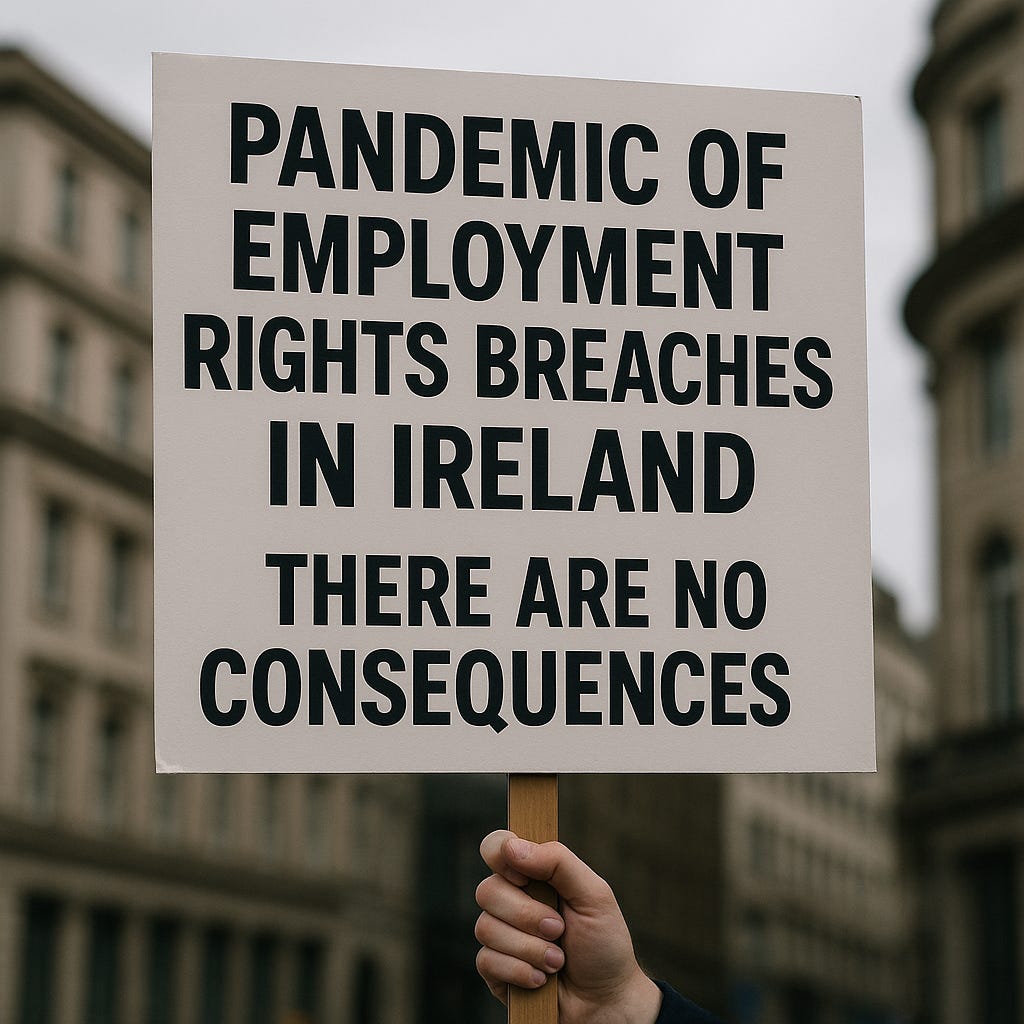
Employment Rights? What Rights?
Ireland’s Employment Rights “Pandemic”: Plenty of Laws, Not Enough Consequences
Ireland loves a good story about being “pro business,” as if the only two options are “attract jobs” or “treat workers like disposable cutlery.” The result is a growing pattern that feels less like isolated bad employers and more like a system that quietly rewards corner cutting. You can call it a “pandemic” of breaches if you want. The more boring term is “predictable incentives.”
The Workplace Relations Commission (WRC) is absolutely doing work. It inspects employers, issues decisions, and recovers unpaid wages. In 2024, it completed 5,156 inspections, found contraventions in 2,108 cases, and recovered about €2.16m in unpaid wages. kpmglaw.ie
But here’s the part people notice in real life: many companies still act like consequences are optional, especially when the worker is new, on probation, or under the one year qualifying service barrier for unfair dismissal. The law exists, but it does not always bite at the moment that matters most, which is when a worker is being pushed out fast and quietly.
Even when a worker wins at the WRC, enforcement can become its own obstacle course. The WRC has a civil enforcement function, but the numbers show how often the system relies on employers voluntarily doing the right thing. In 2024, 130 civil enforcement cases were dealt with and in only 13 cases employers paid without a court order. That is not a “deterrent,” it’s a gentle suggestion. kpmglaw.ie
This is why the public mood is sour. People are not imagining the problem. They’re reacting to a system where process is routinely ignored, the worker has to carry the risk and the cost of fighting back, and companies often bet that the person will walk away.
And yes, the political layer matters. When workers see slow reform, light penalties, and a culture of “sure it’ll be grand,” they assume the government is listening harder to lobbyists than to ordinary employees. You don’t need a conspiracy. You just need inertia, influence, and plausible deniability.
The One Year Rule and Probation: The Sweet Spot for Abuse
Under the Unfair Dismissals Acts, the general rule is that an employee needs more than one year’s service to be protected from unfair dismissal, with well known exceptions. This is stated plainly in parliamentary materials and official answers. Oireachtas+1
That threshold is supposed to give employers room to assess suitability. In practice, it creates a clean window where bad employers can terminate people with minimal fear of an unfair dismissal claim, especially if they keep the paperwork vague and the “reasons” slippery. It becomes a risk management tactic.
Probation is where this gets weaponised. A worker can be put under constant “informal feedback,” denied proper warnings, denied fair procedures, then dismissed with a shrug and a bland line about “not being the right fit.” The problem is not probation existing. The problem is probation being treated as a legal vacuum where basic fairness can be ignored.
There’s also a second layer of nonsense. Even where a person cannot access an unfair dismissal claim due to service length, employers still tend to run disciplinary style meetings, “fact finding,” and performance processes that sound official, but are executed badly. They create the impression of fairness without delivering it. That is how companies create plausible cover while still pushing someone out.
Ireland’s enforcement model often focuses on getting employers “back into compliance,” which sounds reasonable until you remember that workers are not a reusable training aid for HR departments. If a business only becomes compliant after harm is done, the worker has already paid the price. kpmglaw.ie
If you want a simple test for whether a system is being abused, ask this: does the company behave differently at month 13 than it did at month 11. If yes, you are not looking at “culture.” You’re looking at a calculated legal threshold.
What the Cases Are Actually Showing
If you read the WRC’s own published material, the recurring theme is not “technicalities.” It’s basic procedure, basic documentation, and basic respect for statutory rights. When those basics are missing, employers lose, sometimes spectacularly.
One high profile example repeatedly referenced in summaries is the WRC unfair dismissal finding involving a major social media company, where the adjudication officer held that an employee not clicking “yes” in response to a CEO email did not amount to resignation, and awarded very substantial compensation. kpmglaw.ie
That kind of decision matters because it punctures a modern corporate fantasy: that employers can convert silence, non-response, or refusal to accept unilateral change into “voluntary resignation.” The WRC’s approach in that case, as summarised, was blunt: resignation needs clarity. Employers need substantial grounds and fair process. kpmglaw.ie
Zoom out from the big names and the same pattern shows up in ordinary workplaces. The WRC’s ten-year anniversary case report includes examples where multiple statutory breaches stack up alongside unfair dismissal findings, including failures around annual leave, public holidays, and written terms. Workplace Relations Commission
The point is not that every worker will get a life changing award. The point is that the legal standard is often basic and companies still fail it. They do not document. They do not investigate properly. They do not follow their own procedures. They do not give clear notice. Then they act surprised when they lose.
The volume of complaints also tells its own story. In 2024, unfair dismissal complaints comprised 15% of cases received by the WRC, according to an analysis of the WRC annual report statistics. That is not a niche issue. That is a mainstream feature of Irish employment disputes. kpmglaw.ie
Enforcement: Where “Winning” Still Doesn’t Feel Like Winning
Ireland has a weird gap between “rights on paper” and “pain in real life.” The WRC can issue decisions, but the system still relies heavily on workers pushing, waiting, and sometimes going further to enforce outcomes. That friction is part of why companies gamble.
The enforcement stats are revealing. Out of 5,156 inspection cases closed in 2024, contraventions were found in 2,108. Prosecutions were taken in 175 cases where employers failed to become compliant after the inspection process. That sounds firm until you realise the scale: thousands of breaches, a much smaller funnel of serious consequences. kpmglaw.ie
Even the phrase “successful outcomes” in prosecutions includes probation and charitable donations. That can be appropriate in context, but it does not exactly scream “deterrence” to the average worker watching their income collapse after a dodgy dismissal. kpmglaw.ie
The civil enforcement numbers matter too. 130 civil enforcement cases were dealt with in 2024, and only 13 were resolved by employers paying without needing a court order after WRC intervention. That implies that, often, enforcement is still a grind. kpmglaw.ie
This is the core of the “no consequences” feeling. It’s not that there are zero consequences. It’s that consequences are delayed, inconsistent, and frequently require the worker to keep fighting long after they should have been able to move on with their life.
Meanwhile, large international employers can absorb process costs like it’s a line item. A worker cannot. That asymmetry is where impunity lives, even when the formal law looks fine from a distance.
Politics and Reform: People Are Calling This Out, Slowly
The qualifying service threshold for unfair dismissal is not sacred. It’s a policy choice. Other countries tweak it, and Ireland could too. The question is not “can we.” The question is “who benefits if we don’t.”
There have been explicit political calls to reform unfair dismissals law. The Labour Party has publicly called for an overhaul that includes reducing the qualifying service requirement from twelve months to six months, introducing exemplary damages up to two years’ pay, and shifting parts of the mitigation burden back toward employers. The Labour Party+1
Sinn Féin has also published proposals to update the Unfair Dismissals Act, including pushing for stronger deterrence through higher awards caps, framed as necessary to make rights real rather than symbolic. sinnfein.ie
There is also formal legislative activity around remedies. For example, an Oireachtas bill listing exists for “Workplace Relations (Exemplary Damages, Unfair Dismissals…)” which signals that the idea of tougher consequences is not fringe, it is on the legislative agenda in some form. Oireachtas
On the government side, official parliamentary answers still repeat the current framework, emphasising that the Unfair Dismissals Acts protect employees with more than one year’s service. That is accurate, but accuracy is not the same as adequacy. Oireachtas+1
If Ireland wants to stop this cycle, reform cannot just be “more awareness.” It has to change incentives. Faster access to protection, stronger procedural duties during probation, and sharper penalties for repeat offenders are the obvious levers.
What Should Change: A Practical Blueprint
First, reduce the qualifying service threshold. Six months is a workable middle ground that still allows genuine assessment, while removing the obvious “month 11 exit” incentive. The Labour proposal to halve the requirement to six months is aligned with that logic. The Labour Party+1
Second, make probation procedural duties explicit. If an employer is going to end someone’s employment for performance or conduct during probation, require minimum standards: written concerns, a real chance to respond, a defined improvement window unless there is genuine gross misconduct, and a clear decision rationale. The law already cares about fair procedure in practice. It should stop pretending probation is a free-fire zone.
Third, increase deterrence. If the worst case outcome for an employer is “pay some of what you should have paid anyway,” then breaches become a business decision. Proposals for exemplary damages and higher caps exist precisely because deterrence is missing. The Labour Party+1
Fourth, speed up enforcement and make it automatic where possible. Workers should not have to become amateur litigators to see a decision honoured. The WRC’s own civil enforcement caseload shows the system still depends too much on follow-through after the decision stage. kpmglaw.ie
Fifth, target repeat offenders with escalation. If a company is found in breach across multiple inspections or multiple decisions, consequences should scale quickly. Right now, the system reads too often like: breach, comply later, move on, repeat. kpmglaw.ie
Finally, publish better data in a way normal people can understand. The WRC reports contain valuable information, but Ireland needs a public-facing scoreboard that shows repeat breaches, sectors with persistent non-compliance, average time to enforcement, and outcomes. Sunlight is not a substitute for penalties, but it helps stop the gaslighting.
Closing: Rights That Arrive Late Are Not Rights
Ireland does not have a total absence of employment law. It has an enforcement and incentive problem. The WRC is active, the case law shows real standards being applied, and politicians have begun putting reform ideas on the table. sinnfein.ie+3kpmglaw.ie+3Workplace Relations Commission+3
But until workers can realistically access protection earlier, and until employers feel genuine downside risk for procedural abuse, the same story will keep repeating: probation becomes a dumping ground, the one year rule becomes a loophole, and “process” becomes theatre.
International employers are not uniquely evil. They are simply very good at optimising around weak enforcement. Ireland should stop making that easy.
If the state wants to claim it protects workers, it needs to make that protection arrive on time, with consequences that are felt, not merely recorded in a PDF.