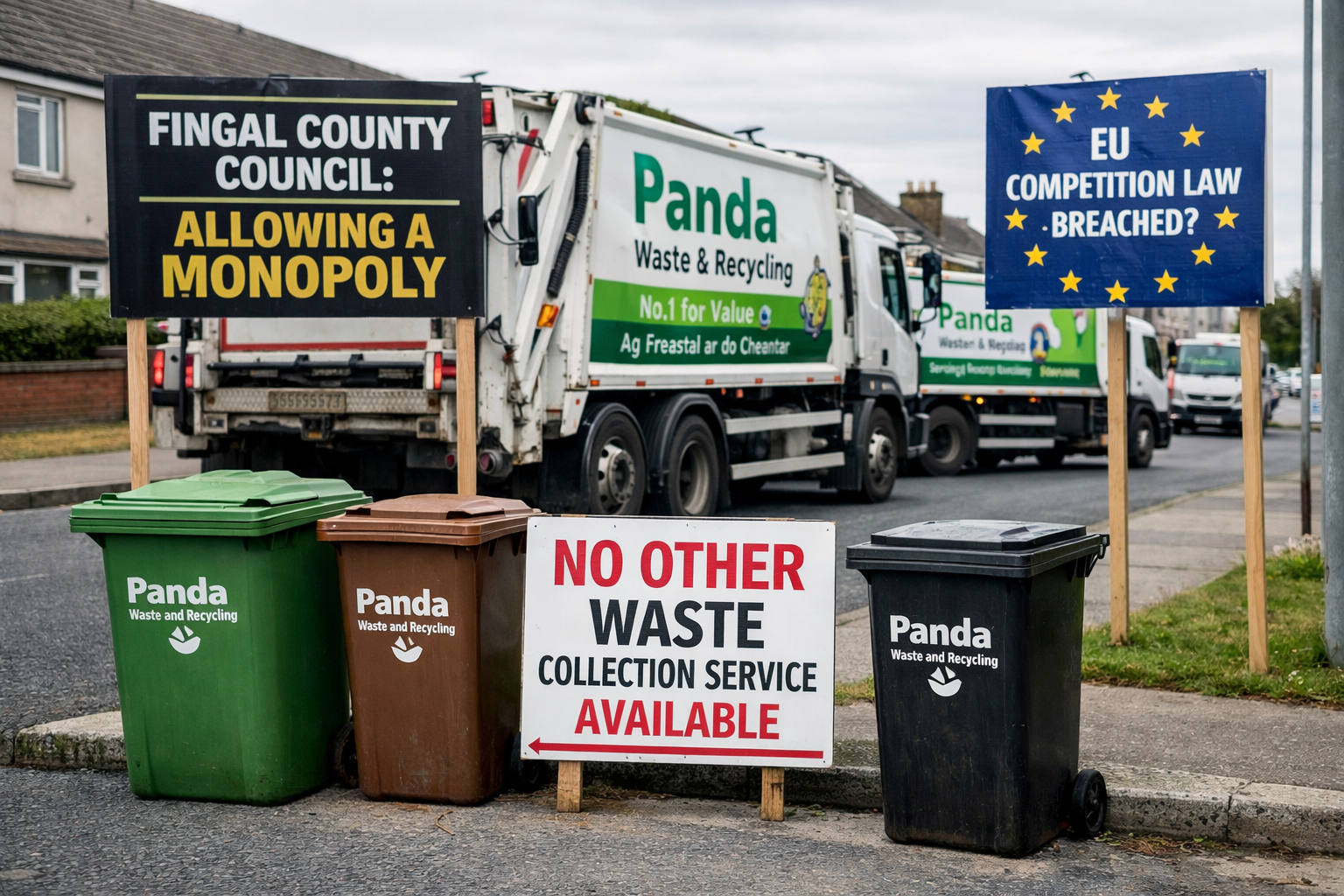
Panda Waste’s De Facto Monopoly in North Dublin Is a Competition Failure
How Fingal County Council allowed one operator to dominate Lusk, Rush, Skerries and Balbriggan, leaving households with no real choice.
North Dublin residents don’t have a market, they have a default
People in Lusk, Rush, Skerries and Balbriggan keep running into the same reality: they try to switch household waste provider and they hit a wall. A market only exists when consumers can credibly walk away. When households cannot find a second operator who will actually take them on, the “market” becomes a slogan, not a service.
Ireland’s household waste model relies on private firms competing for customers. That model only works when multiple firms actively serve each area, not when entire towns sit inside one company’s practical footprint. The moment consumers lose the ability to switch, price discipline dies and service standards drift.
The State already holds the tools to test this claim properly, not through anecdotes, but through permits and coverage. The National Waste Collection Permit Office (NWCPO) runs a public database that lets anyone search permits and authorised collectors. That database tells you who has permission, but it does not guarantee those operators will offer household collection to your address. North West College of Teaching+1
Fingal itself directs residents to check permits through the NWCPO and warns about unauthorised collectors. Fingal therefore recognises that permits and enforcement matter. Fingal County Council+1
If residents can’t get service quotes from anyone except Panda, then north Dublin does not function as a competitive market. It functions like a one-supplier zone. People call that a monopoly because plain English still works.
What EU and Irish competition law actually says
EU competition law does not ban dominance. It bans the conduct that dominance enables. Article 102 TFEU prohibits abuse of a dominant position and lists examples like imposing unfair prices or unfair trading conditions, or limiting markets to the prejudice of consumers. EUR-Lex
Article 101 TFEU targets anti-competitive agreements and concerted practices that restrict competition, including fixing prices or trading conditions. That matters when firms coordinate, carve up territory, or create systems that keep rivals out. EUR-Lex
Ireland mirrors this framework in domestic law. The CCPC explains that Irish law prohibits abuse of dominance and that dominance itself is not illegal, only the abuse. CCPC+1
The public body angle matters too. EU law does not ignore the State when the State helps build monopoly conditions. Article 106 TFEU states that Member States must not enact or maintain measures contrary to the Treaty competition rules when they grant special or exclusive rights to undertakings. Competition Policy
That legal architecture gives you a clear target: you do not need to prove a cartel. You need to show that households face a dominant supplier in practice, that the dominant supplier can impose terms because people cannot switch, and that Fingal’s actions or omissions help sustain those conditions.
What Fingal actually did, and why it matters
Fingal did not just “step back” from household waste. Fingal sold its residential and commercial waste collection service to Panda after what Fingal described as a competitive sale process, with effect from 1 November 2011. Fingal recorded that decision in official budget documentation. Fingal County Council+1
Public records and reporting from that period describe Fingal’s decision to stop running the service itself because it did not want to keep taking losses, and it reached agreement with Panda to provide the service to existing customers. Independent+1
Fingal then shifted into a posture where it polices illegal dumping and waste compliance while the household market “sorts itself out.” Fingal’s Waste Bye-Laws Project explicitly focuses on household compliance and accountability. Fingal County Council+1
That policy choice matters because Fingal does not just manage litter. Fingal shapes the conditions under which waste firms operate locally through enforcement priorities, waste bye-laws, and how it frames authorised collectors to the public. Fingal tells residents to check permits and it positions itself as an authority over legitimate collection. Fingal County Council+1
If whole towns end up with one practical supplier, then Fingal cannot pretend it plays no role. Fingal helped set the structure, Fingal continued to govern the environment, and Fingal failed to ensure real consumer choice developed after the sell-off.
Where Fingal’s conduct can breach competition principles
EU competition law targets undertakings, but EU law also restrains Member States when they grant special or exclusive rights, or when state measures render competition rules ineffective. Article 106 puts that obligation in black and white for special or exclusive rights scenarios. Competition Policy+1
You do not need a document titled “exclusive rights” to create exclusive effects. When a public authority sells an essential service and then allows a market design that results in one realistic operator across large connected areas, it can create the same outcome that Article 106 tries to stop: an operator gets protection from meaningful rivalry in a defined geography. EUR-Lex
The High Court already dealt with a related principle in the waste sector. In 2009, the High Court ruled against Dublin local authorities over a variation to a waste plan that would have excluded private operators and altered the domestic waste collection market. That case shows that competition law concerns do not sit outside waste policy. They sit at its centre. The Irish Times+2ESRI+2
When Fingal builds enforcement and compliance pressure around household collection, but does not build entry and switching conditions that make competition real, it strengthens lock-in. It can also increase the cost of non-participation, which pushes households deeper into dependence on the dominant operator. Fingal’s bye-laws work will tighten that compliance net, not broaden consumer choice. Fingal County Council+1
That is the core allegation you can defend: Fingal created a structural dependence through the 2011 sell-off, then Fingal failed to correct the market outcome when that structure produced one-supplier conditions in specific towns. That pattern aligns with exactly what EU competition rules try to prevent: state-enabled dominance that harms consumers.
What “abuse” looks like when households cannot switch
Article 102 names unfair prices and unfair trading conditions as classic abuse patterns. A dominant operator does not need to break the law loudly. It can simply raise charges, add fees, and tighten terms because customers cannot credibly exit. EUR-Lex+1
Reporting from Dublin 15 shows councillors explicitly worrying about Panda’s dominance and repeated price changes, and discussing ways to rein in charges. That public discussion matters because it shows elected officials already recognise the power imbalance in Fingal’s orbit. Dublin InQuirer+1
The CCPC has spent years warning that the household waste collection market structure trends toward consolidation and will not deliver for the public without economic regulation. In 2018, the CCPC recommended an economic regulator for household waste collection. In 2025, it again warned that the current structure “will never deliver” for the Irish public. CCPC+2CCPC+2
That is not a rhetorical point. It gives you a defensible spine: the national competition authority already sees a systemic failure pattern, including consolidation and weak entry. CCPC+1
So when residents in Lusk, Rush, Skerries and Balbriggan report they cannot find alternatives, they may not describe a weird local story. They may describe the expected outcome of an unregulated essential service market that keeps consolidating.
The evidence that makes this article lethal
You need to prove two things clearly: who can legally operate in the area, and who will actually offer service to a household customer today. The NWCPO database can help with the legal permission piece, but you must document the real availability gap. North West College of Teaching+1
Start with a simple address list. Pick a small spread across the four towns, for example three Eircodes per town, and request quotes from every permitted operator whose permit appears to cover the area. Document every refusal, every “not in your route,” every “we do not take new customers there,” every non-response, and every condition that makes switching unrealistic.
Then tie those outcomes to competition law concepts. If only one operator will supply, then the dominant operator holds power. Article 102 treats unfair prices, unfair conditions, and limiting markets to the prejudice of consumers as classic abuse categories. EUR-Lex
You should also pull Fingal’s own paper trail. Fingal’s budget document confirms the sale to Panda and frames it as a competitive process. That gives you the key question: if Fingal sold the service in 2011 and a de facto monopoly emerged in certain towns, what corrective action did Fingal take over the next decade to protect consumer choice? Fingal County Council+1
Finally, use the CCPC’s own findings as a benchmark and compare your local results against its warnings about market structure and consolidation. That turns your piece from “one town is annoyed” into “one town proves the national regulator’s warnings.”
What taxpayers lose when Fingal allows one-supplier zones
Households pay more when they lose switching power. That is the most basic consumer harm. A dominant supplier can add fees and change terms because customers cannot punish it by leaving, and that dynamic sits at the heart of Article 102’s unfair pricing and unfair trading conditions language. EUR-Lex
Taxpayers also fund the cleanup when the system breaks. Fingal spends public money on illegal dumping responses and enforcement. Fingal itself highlights dumping as a recurring problem. When households feel squeezed and trapped, dumping risk climbs, and the public pays. Fingal County Council+1
Fingal’s current response focuses on compliance and accountability for households, not on fixing the market structure that shapes household behaviour. Fingal’s bye-laws project seeks accountability of all households, which increases enforcement pressure. It does not increase competition. Fingal County Council
That mismatch creates a moral hazard. Fingal can tighten enforcement on residents while allowing the supplier landscape to remain effectively closed. Residents then face a hard choice: pay whatever the dominant operator demands, or risk penalties. That is not a “market.” That is coercion wrapped in paperwork.
What Fingal and the State must do if they claim to support competition
Fingal should publish a clear, address-level “service availability map” built from real supplier commitments, not just permit lists. Fingal already points residents to permits, so it already acknowledges it has a role in public assurance. Fingal County Council+1
Fingal should formally ask the CCPC to assess whether the structure in these towns produces local dominance and consumer harm. The CCPC has already called for economic regulation and it has warned that the current structure will never deliver for the public. Fingal should stop acting surprised and start acting responsible. CCPC+1
Government should implement what the CCPC recommended in 2018, an economic regulator for household waste collection, with the power to shape market design and protect consumers. The CCPC has kept repeating that recommendation because the problem never went away. CCPC+2CCPC+2
If Fingal wants to keep a privatised model, it must enforce the one thing that makes privatisation defensible: real competition. If Fingal cannot deliver that, it should support a franchised or regulated model that guarantees coverage, fair pricing rules, and real switching pathways.
Closing: this is not a “Panda issue,” it is a Fingal failure
Panda operates inside a system that rewards scale and punishes entrants. Panda can still abuse dominance, and the law can still stop that. Article 102 exists for exactly this scenario. EUR-Lex
Fingal sits closer to the root. Fingal sold the service in 2011 and it allowed the market outcome to harden into local dependence in areas that now appear to have one realistic operator. Fingal then focused on compliance enforcement and illegal dumping while leaving consumer choice to die quietly. Fingal County Council+2Fingal County Council+2
EU law does not give states a free pass when state measures grant or reinforce special or exclusive effects that undermine competition. Article 106 exists because governments love pretending monopoly outcomes “just happened.” Competition Policy+1
If residents in Lusk, Rush, Skerries and Balbriggan can’t get a second provider to take them, then the system failed them. Panda benefits. Fingal enabled. The State ignored warnings. The public pays.
If you want this to land like a hammer, the next step is simple: give me one Eircode in each town and I’ll use the NWCPO data and a documented competitor list to build a hard “who can serve, who will serve” evidence block that Fingal and the CCPC cannot wave away.

Related Posts